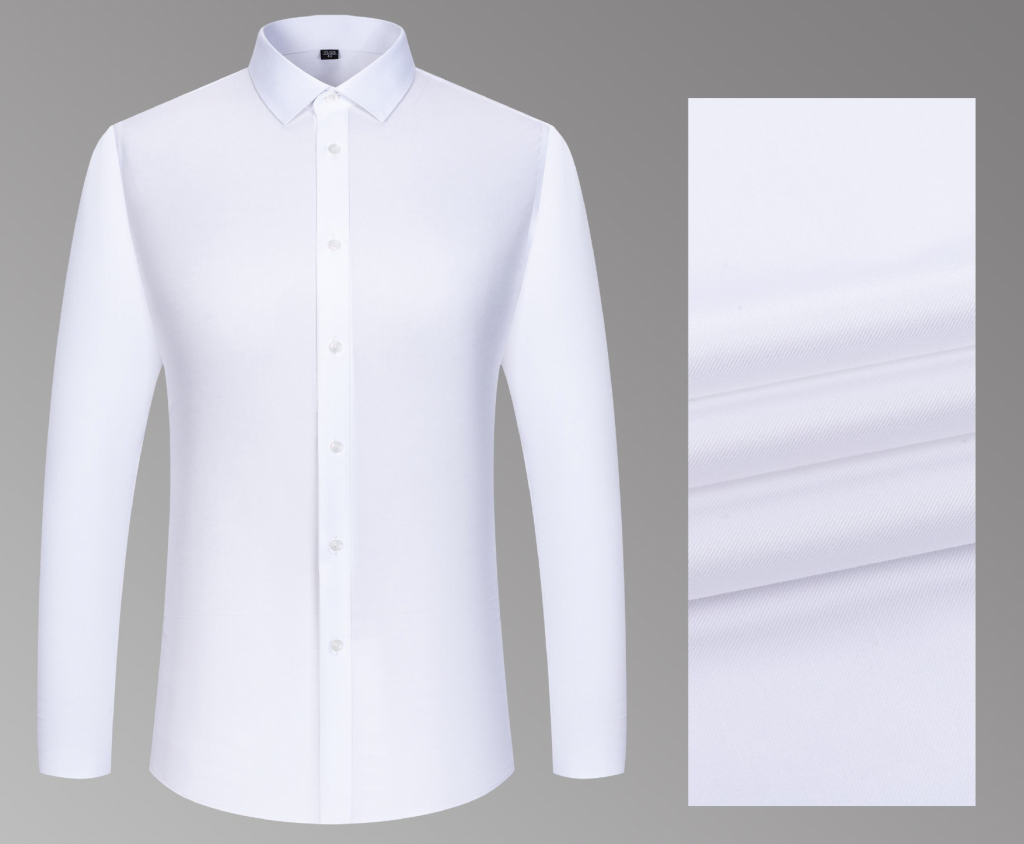
When discussing wrinkle-resistant shirts, many manufacturers and buyers tend to mix the concepts of EASY CARE, WRINKLE FREE, and NON-IRON. In actual production, however, these terms represent different performance standards, technologies, and manufacturing requirements.
One of the key indicators behind these categories is the DP rating (Durable Press rating), which reflects the wrinkle recovery appearance of fabrics or garments after washing and drying.
Generally speaking:
• DP 2.0–3.0 is usually categorized as EASY CARE, typically achieved through fabric finishing only.
• DP 3.0–4.0 is generally referred to as WRINKLE FREE, combining advanced fabric treatment with taped seam applications during garment sewing.
• DP 3.5–4.5 is considered NON-IRON, requiring post-cure garment processing together with fully taped seam construction.
Different performance levels require different technical approaches.
• EASY CARE
EASY CARE treatments improve wrinkle recovery and simplify daily maintenance, although garments still require light ironing after laundering.
In practice, this level is commonly achieved through resin finishing applied to fabrics.
It is also worth noting that some fabrics naturally show better wrinkle resistance due to their fiber composition or fabric structure. For example, fabrics containing polyester or microfiber yarns, as well as Oxford textures, may also be marketed as EASY CARE because of their inherent physical wrinkle resistance.
• WRINKLE FREE
WRINKLE FREE garments provide stronger crease resistance and maintain a cleaner appearance after laundering, although touch-up ironing may still be required depending on wearing conditions.
This performance level is commonly achieved through technologies such as Liquid Ammonia treatment and Moisture Cross-linking finishing. In garment production, taped seams are also frequently applied to improve wrinkle recovery performance.
• NON-IRON
NON-IRON represents the highest performance level in wrinkle-resistant shirts.
Garments are expected to maintain their shape and smooth appearance after home laundering with minimal or no ironing required.
This level is typically achieved through post-cure garment-dipping processes, together with fully taped seam construction throughout the garment.
From a manufacturing perspective, achieving higher DP performance is not only about chemical finishing. It also requires careful control during garment production, including fabric stability, sewing tension, seam construction, pressing temperature, and curing conditions.
In many cases, the real challenge is balancing wrinkle resistance, fabric hand feel, garment appearance, durability, and wearer comfort simultaneously.
Hopefully this article helps clarify why not all wrinkle-resistant shirts perform the same — even when the labels appear similar.